Cost Change report
The Cost Change report lists every time the cost of a product on a purchase order was different from its cost on the previous PO. For each change it shows the old and the new cost, both POs and both suppliers, so you can see exactly which order, and which supplier, changed your costs.
Go to Reports > Costs > Cost Change Report. The report is available on paid plans.

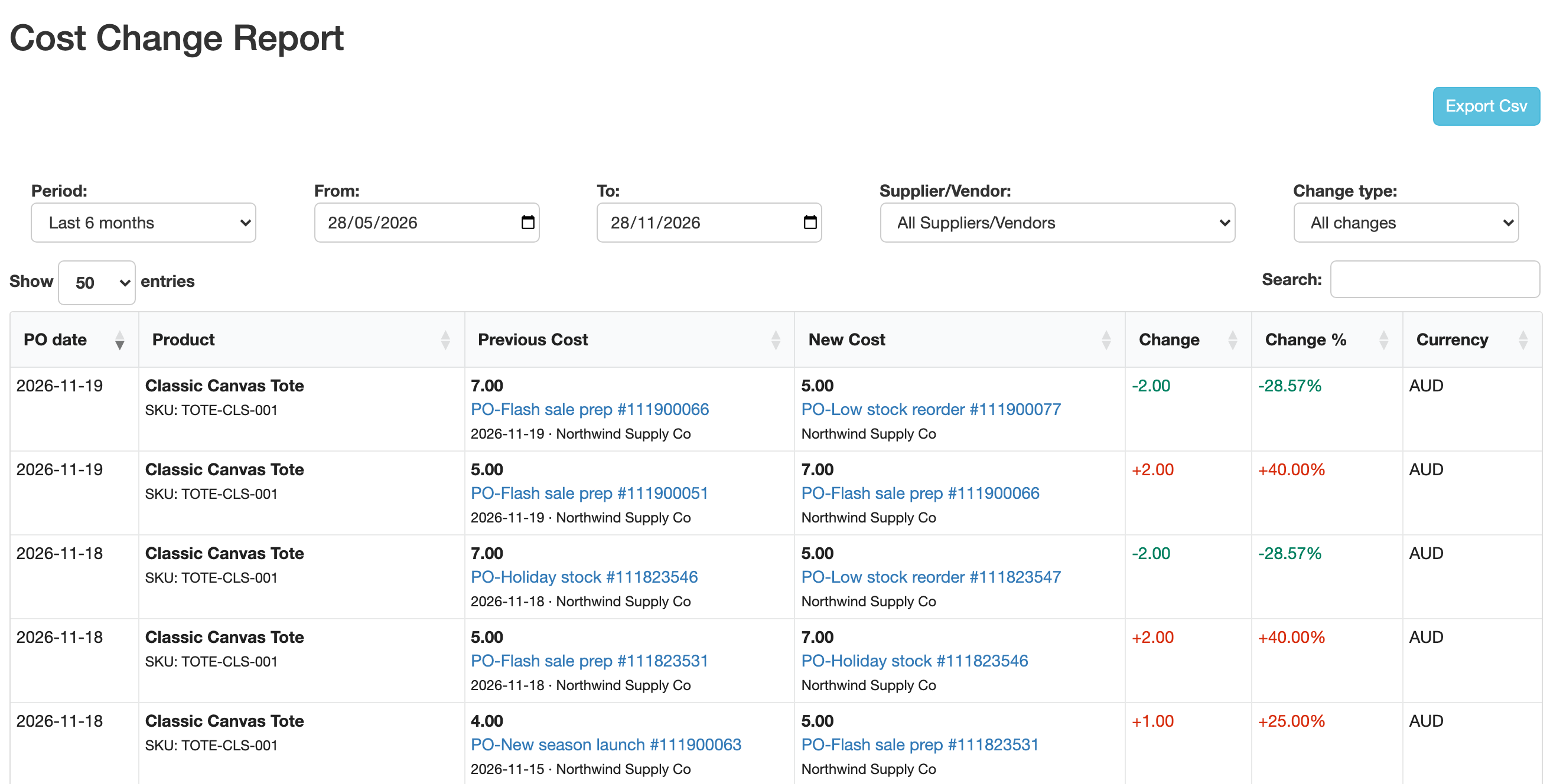
Filter the report
| Filter | What it does |
|---|---|
| Period | Last month, Last 3 months (the default), Last 6 months, Last 12 months, or Custom to pick your own dates. |
| From / To | The dates of the period. If your dates don't match one of the presets, Period shows Custom. |
| Supplier/Vendor | Only show changes on POs from this supplier or vendor (the supplier of the new PO). |
| Change type | All changes, Increase or Decrease. |
The period applies to the new PO's date. The previous PO is looked up in your whole history, so a change on the first PO of the period still shows up even if the previous order was a year ago.
Columns
Each row is one change. A product that changed cost three times in the period has three rows.
| Column | What it shows |
|---|---|
| PO date | The date of the PO with the new cost. |
| Product | The product, variant and SKU. |
| Previous Cost | The cost on the previous PO, with that PO's number, date and supplier. Click the PO number to open it. |
| New Cost | The cost on the new PO, with its number and supplier. |
| Change | New cost − previous cost. Increases are in red with +, decreases in green with -. |
| Change % | The change as a percentage of the previous cost. Shows - when the previous cost was 0. |
| Currency | The currency of both POs. |
Example: you bought Classic Canvas Tote at 5.00 on PO #111900051, then at 7.00 on PO #111900066. The report shows one row: Previous Cost 5.00, New Cost 7.00, Change +2.00, Change % +40.00% (2.00 ÷ 5.00 × 100).
- The cost of a product on a PO is the cost you entered on the PO line, before its Discount (%) and Tax (%). If the same product is on several lines of one PO, the cost is averaged by quantity: 10 units at 4.00 and 30 units at 5.00 count as 4.75.
- Costs are only compared between POs in the same currency. A product bought in USD and then in EUR doesn't show a change.
- Canceled POs, and products added to a PO by hand (not from Shopify), aren't included.
Totals
Below the table:
- Total cost changes: the number of rows.
- Products with cost increase: how many products had at least one increase.
- Products with cost decrease: how many products had at least one decrease.

The totals follow the filters above the table. Typing in Search narrows the table but doesn't change the totals.
Search, sort and pages
- The newest changes are shown first.
- Search: type part of a product name, variant, SKU, PO number or supplier name.
- Click a column header to sort by it, and click again to reverse the order. For example, click Change % twice to see the biggest increases first.
- The report shows 50 changes per page. Change it with Show ... entries, and use Previous, Next or a page number to move between pages.
The report is calculated by the database and loads one page at a time, so it stays fast even with years of purchase orders.
Export to CSV
Click Export Csv to download Cost_Change_Report_<date>.csv with the filters you picked (Search and sorting aren't applied). It has one row per change with the columns PO Date, Product, Variant, SKU, Currency, Previous Cost, Previous PO#, Previous PO Date, Previous Supplier/Vendor, New Cost, New PO#, New Supplier/Vendor, Change and Change %.
FAQ
A product's cost changed but it isn't in the report. Check that the new PO's date is in the period, that it isn't canceled, and that both POs use the same currency.
Why does the same product appear on several rows? Each row is one change between two consecutive POs. A product whose cost went 5.00 → 7.00 → 5.00 has two rows.
Is this the same as cost change alerts? No. Cost change alerts compare the cost on a PO with the product's cost in Shopify when you order or receive. This report compares the costs of your POs with each other, over time.